
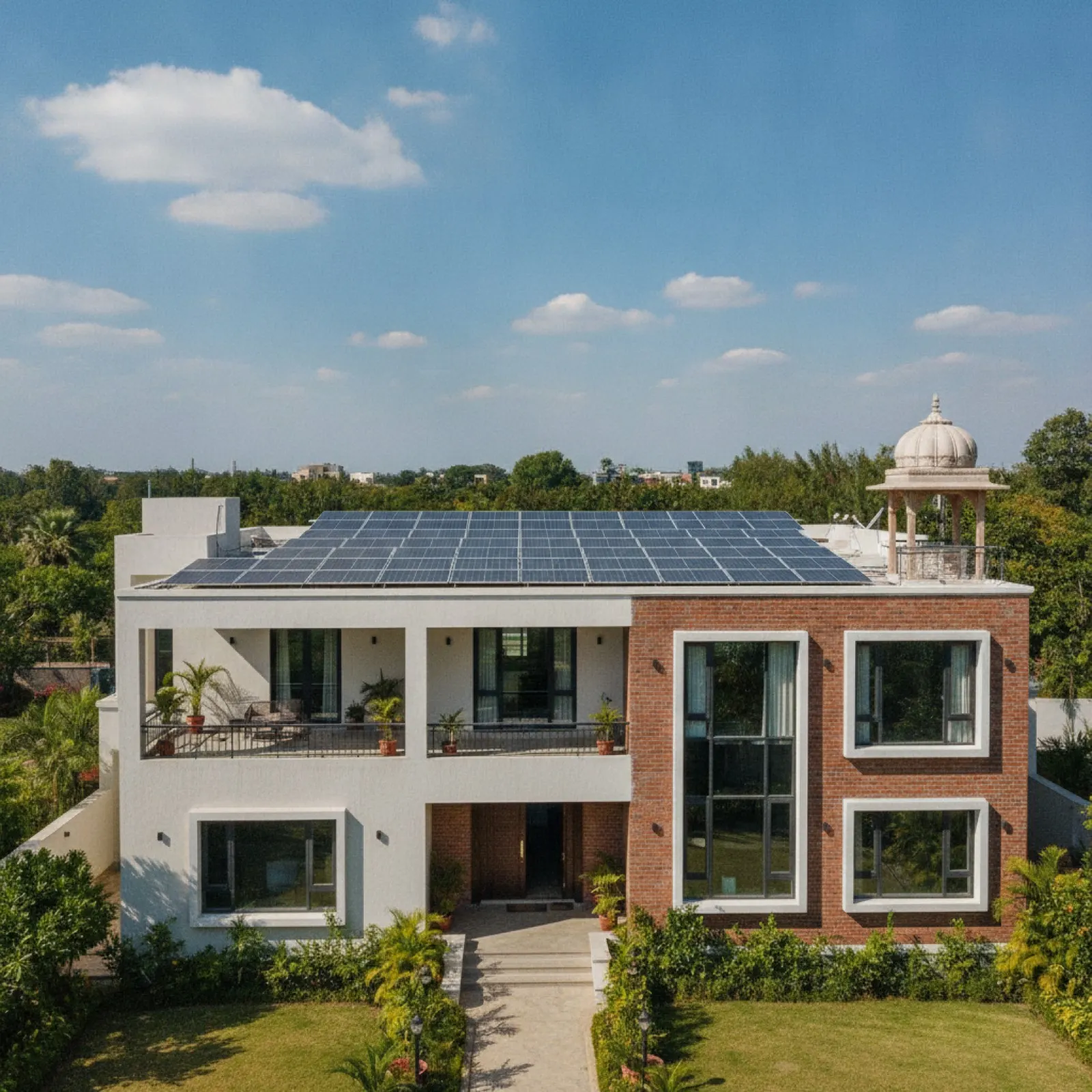
Own Your Power. Zero Your Bill.

Residential Solar

Own Your Power. Zero Your Bill.

Rooftop solar for homes in Bhopal & across MP — with up to ₹78,000 PM Surya Ghar subsidy filed for you, tier-1 panels, and a 5-year comprehensive guarantee. Falak Enterprise built its first Bhopal home array in 2017; since then we have installed 68 systems totalling 278 kW across Madhya Pradesh as an MPMKVVCL-empanelled installer. A typical 3 kW system pays back in 3–4 years after subsidy and can cut a household bill by up to 90%.

Why Rooftop Solar

Your Roof Can Pay Your Power Bill

currency_rupee

Up to ₹78,000 Subsidy

PM Surya Ghar Muft Bijli Yojana pays ₹30,000/kW for the first 2 kW and ₹18,000 for the third — credited straight to your bank account after commissioning. We handle the entire portal application for you.

receipt_long

Near-Zero Bills

A right-sized 3 kW system generates ~4,200 units a year in Bhopal — typically the full consumption of a 3-BHK home. Net metering credits every extra unit you export to the grid.

savings

Payback in 3–4 Years

After subsidy, a residential system typically pays for itself in 3–4 years — then generates free power for the next 21+. Panels carry a 25-year performance warranty.

Typical Home Systems & Pricing

SystemBest forApprox. cost*SubsidyEst. yearly savings
2 kWBills ₹1,500–2,500/mo₹1.45 L₹60,000₹24,000+
3 kWBills ₹2,500–4,000/mo₹2.0 L₹78,000₹36,000+
5 kWBills ₹4,000–7,000/mo₹3.0 L₹78,000₹60,000+
10 kWVillas / high usage₹5.2 L₹78,000₹1,20,000+

*Indicative turnkey prices incl. GST; exact quote depends on roof, phase and structure. Get a precise figure from our calculator or a free site visit.

From Enquiry to Generation — 4 Weeks

01

Free Site Survey

Engineer measures roof, checks shading and your sanctioned load. Same-week visit anywhere in Bhopal.

02

Design & Subsidy Filing

Custom layout, exact quote, PM Surya Ghar portal registration and DISCOM paperwork — all done by us.

03

Installation (2–3 days)

PPGI structure, tier-1 panels, certified wiring with earthing and lightning protection. Clean handover.

04

Net Meter & Subsidy Credit

We liaise with MPMKVVCL for the net meter, commission the system, and your subsidy lands in your bank.

How to Size Your System by Monthly Bill

The simplest way to size a home system is to work backwards from what you already pay. In Bhopal each kilowatt of rooftop solar generates roughly 1,400 units a year — about 4 units a day averaged across bright summers and dimmer monsoon weeks, at the district's typical 5.2 peak sun hours. At the prevailing MP residential tariff of around ₹7.50 per unit, one kilowatt therefore offsets close to ₹10,000 of billing a year. Match your annual consumption to that and you land on the right size without over-building.

If your monthly bill sits between ₹1,500 and ₹2,500, you are consuming roughly 200–330 units a month, and a 2 kW system covers most of it — generating about 2,800 units a year against a subsidy of ₹60,000. Bills in the ₹2,500–₹4,000 range point to a 3 kW system, the sweet spot for a typical 3-BHK home: it produces around 4,200 units a year, attracts the full ₹78,000 PM Surya Ghar subsidy, and usually erases the bill entirely once net-metering credits are counted. Households running air-conditioning through the summer and paying ₹4,000–₹7,000 a month generally need a 5 kW system (about 7,000 units a year), while villas and high-usage homes above ₹7,000 a month move to 10 kW and beyond.

Two things shift the final number. Shadow-free roof area caps the size — a 3 kW array needs roughly 300 sq ft clear of water tanks, parapets and tree shade — and your sanctioned load with MPMKVVCL sets an upper limit on what can be net-metered. Our engineer confirms both on the free site visit. You can also model your own figure in seconds with the solar savings calculator before you call.

The PM Surya Ghar Subsidy, Start to Finish

PM Surya Ghar Muft Bijli Yojana is a central-government subsidy paid directly into your bank account by Direct Benefit Transfer after your system is commissioned and inspected. The structure is tiered: ₹30,000 per kilowatt for the first two kilowatts and ₹18,000 for the third, which is why a 1 kW system draws ₹30,000, a 2 kW system ₹60,000, and any system of 3 kW or larger draws the capped maximum of ₹78,000. The scheme is open to residential electricity connections and currently runs to 31 March 2027.

In practice the paperwork is the part homeowners dread, so we do it. After you approve the design we register your application on the national PM Surya Ghar portal, upload your latest electricity bill and Aadhaar, submit the technical feasibility request to MPMKVVCL, and track the approval. Only after that sanction do we install. Once the system is up we file for the net meter, attend the DISCOM inspection on your behalf, and submit the commissioning report and your bank details that release the subsidy. You sign a couple of times and receive the money — you never have to navigate a government portal yourself. Our full walk-through of eligibility, documents and realistic timelines is in the PM Surya Ghar subsidy guide for Bhopal.

What Installation Day Actually Looks Like

Physical installation of a home system takes two to three working days and is far less disruptive than most people expect. On the first morning our team arrives with the mounting structure — hot-dip galvanised or PPGI rails engineered to sit on your RCC, tin or tile roof and rated for local wind loads without voiding any roof waterproofing warranty. The structure goes up and is anchored the same day.

Day two is panels and electrical work: tier-1 modules are bolted to the rails, strung together, and connected through the inverter to your main board with proper earthing and lightning protection. Cable runs are clipped and routed neatly rather than left draped across the roof. By the end of the second day — or partway through a third for larger arrays — the system is mechanically complete and safety-tested. Your household power is only interrupted for a short, planned window while the inverter is tied into the board. We clean the site before we leave; there is no rubble or offcut waste left behind. The system then waits on the net meter and DISCOM commissioning before it begins exporting, which we schedule and attend for you.

Maintenance & Warranty — The Honest Version

Solar has no moving parts, so the maintenance reality is genuinely light — but it is not zero, and it helps to know the truth before you buy. The one job that matters in Madhya Pradesh is cleaning. Dust settles fast here, and a dirty array can lose 10–15% of its output over a few weeks in the dry season. Panels need a rinse roughly twice a year, more often through the pre-monsoon dust. Beyond that, the inverter deserves a visual check every six months, and cabling and earthing should be inspected annually. Our AMC plans cover all of this so you are not up on the roof yourself.

On warranty, be clear about what covers what. The panels themselves carry a 25-year performance warranty from the manufacturer — they will still produce around 80% of their rated output at year 25. The inverter, the one component that does eventually wear, typically carries a 5-to-10-year warranty depending on brand. On top of the manufacturer cover, Falak Enterprise provides a 5-year comprehensive workmanship warranty on the installation, one year of system insurance that can be extended, and daily remote monitoring so a drop in generation is flagged before you would ever notice it on a bill. A well-installed system realistically runs for 25 years and more; the warranties are there for the rare fault, not the routine.

Free Site Visit

Get Your Home Solar Estimate

Tell us your monthly bill and we will call back with a right-sized system, the exact subsidy, and a to-the-rupee savings figure. No cost, no obligation. Prefer to model it yourself first? Use the savings calculator.

Residential FAQs

Will solar work during a power cut?add

Standard on-grid systems shut off during outages for lineman safety. If backup matters, we design hybrid systems with batteries — ask during your site visit.

What roof do I need for 3 kW?add

About 300 sq ft of shadow-free roof. RCC, tin and tile roofs all work — the mounting structure changes, not the panels.

Is the subsidy really paid to me directly?add

Yes — under PM Surya Ghar the subsidy is DBT (direct bank transfer) to your account after commissioning and inspection. We file everything; you just receive it. The scheme currently runs to 31 March 2027.

What do you guarantee after installation?add

5-year comprehensive workmanship warranty, 1-year insurance (extendable to 29), daily remote monitoring, panel-cleaning system, and AMC plans that keep the system at peak output for its 30-year life.

Lock In Your ₹78,000 Subsidy Before 31 March 2027

The PM Surya Ghar scheme runs only to March 2027, and we file the whole application for you. Book a free site visit and our engineer will size your system and tell you exactly how much your home will save — to the rupee. An MPMKVVCL-empanelled installer, 68 systems delivered since 2017.

Related Guide

PM Surya Ghar Subsidy in Bhopal: Full Eligibility & Application Guide

Subsidy tiers, documents needed, and realistic application timelines for your home installation.