
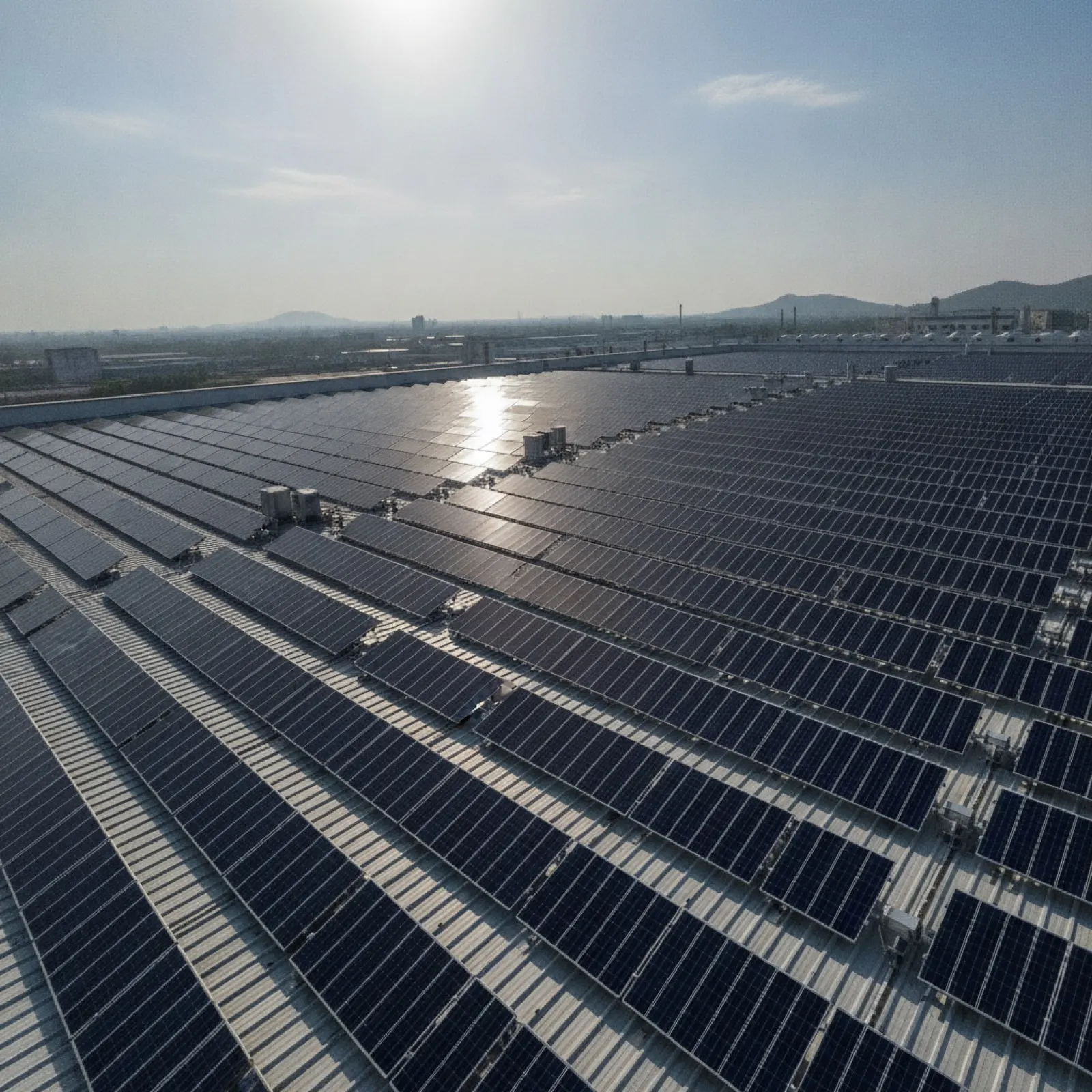
Commercial & Industrial
Offices, institutions, factories and warehouses — cut ₹8+/unit grid power to about ₹2 with a solar asset that pays back in 3–4 years and runs for 25. Falak Enterprise built its first Bhopal commercial array in 2017; since then we have installed 68 systems totalling 278 kW across Madhya Pradesh as an MPMKVVCL-empanelled installer, handling net metering and DISCOM coordination end to end.
Commercial & Industrial
Commercial tariffs in MP run ₹8–9 per unit including duty. Solar generates at an effective lifetime cost near ₹2 — a 70%+ cut on every unit you self-consume.
Businesses claim 40% depreciation on solar assets in year one, plus input-credit treatment on GST — dramatically improving post-tax payback for profitable firms.
High daytime consumption means commercial systems typically recover their cost in 3–4 years — then deliver two decades of near-free power and a visible green credential for your brand.
Rooftop arrays on RCC or metal sheds sized to your daytime load. 3-phase Polycab string inverters, remote monitoring, and net metering handled end-to-end with MPMKVVCL.
Industrial sheds are ideal solar real estate. We deliver HT-connected plants with SCADA-grade monitoring, safety audits, and CAPEX or OPEX/RESCO commercial models.
Let me walk the math the way I would on a whiteboard in your office. Every figure below is an estimate to show how the payback works — your real quote depends on your roof, your tariff and your load — but the method is exactly how we size the return.
Start with generation. Bhopal gives about 5.2 peak sun hours a day, and a plant runs a useful roughly 300 days a year once you allow for monsoon and cleaning downtime. So a 50 kW system makes about 50 × 5.2 × 300 = 78,000 units a year. That is the number everything else hangs off.
Now the savings. I will value each unit at ₹7.50, which is deliberately conservative — commercial and industrial tariffs in MP actually run ₹8–9 a unit with duty, so if anything you save more. At ₹7.50, those 78,000 units are worth 78,000 × ₹7.50 = ₹5,85,000 a year off your bill, assuming you consume most of it in the daytime, which a factory or office does.
Against that, the cost. Turnkey commercial solar lands around ₹40,000 per kW at this size (estimate — it moves with structure height, cable runs and inverter choice), so 50 kW is roughly ₹20,00,000. Divide cost by yearly saving — ₹20,00,000 ÷ ₹5,85,000 — and simple payback is about 3.4 years. After that the power is effectively free for the remaining 20-plus years of a 25-year panel life.
Then the tax angle, which is where a profitable business pulls ahead. Under accelerated depreciation you can write off 40% of the asset value in year one. That is 40% × ₹20,00,000 = ₹8,00,000 of depreciation. At a 25% corporate tax rate that shields 25% × ₹8,00,000 = ₹2,00,000 of tax in the first year alone. Knock that off the cost and your effective outlay is nearer ₹18,00,000, which pulls simple payback down to roughly 3.1 years. The remaining book value keeps depreciating in later years, so there is more shield to come — I have left that out to keep the number honest and conservative. GST input credit on the equipment sits on top of all this for a GST-registered firm.
| Annual generation | 50 kW × 5.2 hrs × 300 days = 78,000 units |
| Yearly saving @ ₹7.50/unit | ₹5,85,000 |
| Turnkey cost (est. ₹40,000/kW) | ₹20,00,000 |
| Simple payback | ≈ 3.4 years |
| Year-1 depreciation (40%) | ₹8,00,000 |
| Year-1 tax shield @ 25% | ₹2,00,000 |
| Effective payback after shield | ≈ 3.1 years |
Send us 12 months of bills and we replace every estimate above with your real figures. Model a rough number yourself in the savings calculator.
Free Load Study
Tell us your connected load and we come back with a load study, system sizing, a generation model and CAPEX and OPEX options — free. Send 12 months of bills afterwards for exact numbers.
PM Surya Ghar applies to residential consumers only. Businesses benefit instead through 40% accelerated depreciation, GST input credit, and much higher per-unit savings — which usually beat the residential subsidy in absolute terms.
CAPEX (you own the asset) maximises savings and tax benefit if capital is available. Under OPEX/RESCO, an investor owns the plant and you simply buy its power at a discounted tariff with zero upfront cost. We model both for you.
No. Roof work is sequenced around your shifts, and grid tie-in needs only a short planned shutdown that we schedule with you and the DISCOM.
Send us 12 months of electricity bills. Within a week you get a load study, system sizing, generation model and a commercial proposal with CAPEX and OPEX options — free.
We turn your bills into a load study, a 25-year generation model and side-by-side CAPEX and OPEX numbers — including the 40% depreciation shield — at no cost. An MPMKVVCL-empanelled installer with 68 systems and 278 kW delivered across MP since 2017.